Gasification-based processes for power production

Gasification-based processes for power production characteristically result in much lower emissions of pollutants compared to conventional coal combustion. This can be traced to the fundamental difference between gasification and combustion: in combustion, air and fuel are mixed, combusted and then exhausted at near atmospheric pressure, while in gasification oxygen is normally supplied to the gasifiers and just enough fuel is combusted to provide the heat to gasify the rest. Since air contains a large amount of nitrogen along with trace amounts of other gases which are not necessary in the combustion reaction, combustion gases are much less dense than syngas produced from the same fuel.

 Pollutants in the combustion exhaust are therefore at much lower concentrations than the syngas, making them difficult to remove. Moreover, gasification is usually operated at high pressure (compared to combustion at near ambient). The inherent advantages in removing syngas contaminants prior to utilization of the syngas emerge as follows:

  • Relatively high concentration of pollutant species and pollutant species precursors (most notably hydrogen sulfide (H2S) in syngas which would form sulfur oxides (SOx) upon syngas combustion), versus much lower concentration that would be found in the combustion flue gas, improves removal;
  • High-pressure gasifier operation significantly reduces the gas volume requiring treatment;
  • Conversion of H2S into elemental sulfur (or sulfuric acid) is technically much easier and more economical than capture and conversion of SO2 into salable by-products;
  • The higher temperature and pressure process streams involved in gasification allow for easier removal of carbon dioxide (CO2) for geological storage or for sale as a byproduct;
  • The oil and gas industries already have significant commercial experience with efficient removal of acid gases (H2S and CO2) and particulates from natural gas.
  • Removal of corrosive and abrasive species prevents potential damage to the conversion devices such as gas turbines, resulting from contamination, corrosion, or erosion of materials.

Emissions Regulations

The Clean Air Act, enacted by Congress in 1963, requires the United States Environmental Protection Agency (EPA) to create National Ambient Air Quality Standards (NAAQS) for any pollutants which effect public health and welfare. As of 2007, the EPA had established standards for ozone, carbon monoxide, sulfur dioxide, lead, nitrogen dioxide, and coarse and fine particulates. These standards are reviewed and updated every five years.

These NAAQS, known as Title I, are administered by each state in conjunction with the EPA. Each state must submit a State Implementation Plan (SIP) to the EPA for approval which details how the state will comply with the NAAQS. The SIP may be more stringent than the Federal requirements, but must meet them at a minimum.

The complications of varying state and local implementation plans generally translate into great variation in the permitting process for new power plants based on their proposed sites. Various state and local regulations and whether or not those areas meet the NAAQS play a large role in the negotiation process for emissions requirements at new plants. Also, the future of emissions regulation is cloudy and more stringent regulations, along with the inevitable increase in worldwide electrical demand, could play a substantial role in determining the eventual market penetration of gasification technology for electrical production.

NETL Comparison of Pulverized Coal Combustion and IGCC Pollutant Emissions

The National Energy Technology Laboratory (NETL) published a detailed performance comparison of three different IGCC technologies along with subcritical and supercritical pulverized coal (PC) power plants (Natural Gas Combined Cycle (NGCC) was also included, however since coal is not the feedstock in that scenario it is not discussed here) entitled Cost and Performance Baseline for Fossil Fuel Plants1 in 2007. Design principles for the IGCC systems were based on best current design practices listed in the Electric Power Research Institute's CoalFleet User Design Basis Specification for Coal-Based Integrated Gasification Combined Cycle (IGCC) Power Plants: Version 4, while the PC plants were modeled based on incorporating the best commercially available technology that could be implemented in a plant to start operation in 2010. Those comparisons illustrated the typical magnitude of emissions reductions possible for the main pollutants/emissions of concern for IGCC-based systems. The three IGCC technologies far outperformed both subcritical and supercritical PC plants in minimizing these criteria emissions. More detailed discussion for individual emissions types can be found at those pages specific to the species in question:

  • SOx
  • NOx
  • PM
  • CO2


Slag and Ash

As discussed in the Background, solid waste from conventional pulverized coal-fired power plants is a significant environmental issue due to the large quantities produced, chiefly of coal fly ash, and the potential for leaching of toxic substances (e.g. heavy metals such as lead and arsenic) into the soil and groundwater at disposal sites, and accidental releases from coal ash ponds.


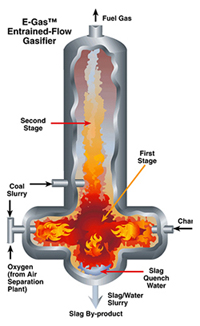
As opposed to conventional coal combustion, many types of coal gasification produce very little fly ash.1 This is a benefit of gasifiers operated at temperatures higher than the fusion point of ash (slagging gasifiers or agglomerating gasifiers, which include the most prominent coal gasification processes incorporated into IGCC such as GE Energy, E-Gas™ and BGL). At such high temperatures, most of the mineral matter of the coal is transformed and melted into slag, an inert glass-like material. Under these conditions, non-volatile metals and mineral compounds are bound together in molten form until the slag is cooled in a water bath at the bottom of the gasifier, or by natural heat loss at the bottom of an entrained bed gasifier. Volatile metals such as mercury are typically not recovered in the slag, but may be removed from the raw syngas during cleanup. Slag production is a function of ash content, so coal produces much more slag than petroleum coke. Regardless of the feed, as long as the operating temperature is above the fusion temperature of the ash, slag will be produced. Its physical structure is sensitive to changes in operating temperature and pressure, and physical examination of the slag’s appearance can often be a good indicator of carbon conversion in the gasifier.


Summary


In summary, gasification has inherent advantages over combustion for emissions control. Emission control is simpler in gasification than in combustion because the produced syngas in gasification is at higher temperature and pressure than the exhaust gases produced in combustion. These higher temperatures and pressures allow for easier removal of sulfur and nitrous oxides (SOx, and NOx), and volatile trace contaminants such as mercury, arsenic, selenium, cadmium, etc. Gasification systems can achieve almost an order of magnitude lower criteria emissions levels than typical current U.S. permit levels and +95% mercury removal with minimal cost increase.

Emissions Advantages of Gasification

The Wabash River Coal Gasification Repowering Project is one of two demonstrations of advanced integrated gasification combined cycle (IGCC) technology in the United States. It was selected by the U.S. Department of Energy (DOE) in September of 1991 as a Round IV Demonstration Project for the Clean Coal Technology (CCT) Program. The IGCC plant is a repowering facility in the sense that it was built to replace a dated conventional pulverized coal power plant. Construction began in July of 1993 near West Terre Haute, Indiana, followed by operational startup in November of 1995. The project demonstration phase was completed and turned over for commercial operation in December 1999. In 2005, the plant was re-started under new management. SG Solutions LLC (SGS) owns and operates the Syngas Plant, whereas Wabash Valley Power owns the power generation portion of the plant, which is operated by Duke Energy.

Project Participants

The Wabash River Coal Gasification Project Joint Venture was formed in 1990 by Destec Energy, Inc. of Houston, Texas and PSI Energy. PSI Energy was an investor-owned utility whose service covered 62 of the 69 counties in Indiana. Along with Cincinnati Gas & Electric Company, PSI was owned by Cinergy Corporation, formed in 1994 and acquired by Duke Energy in 2006. Destec was purchased by Houston-based NGC Corporation, in 1997, and changed its name to Dynegy, Inc. the following year. In December of 1999, Global Energy Inc. purchased Dynegy’s gasification assets and technology. This included Dynegy’s synthesis gas (syngas) facility at the Wabash River Coal Gasification Repowering Project, as well as the right, title and interest in Dynegy’s proprietary gasification technology and related patents. Dynegy’s gasification projects in development at the time were also part of the acquisition. In 2005, the facility was handed over to SGS, who currently owns and operates the plant.

The gasification technology, developed originally by Dow Chemical, was first applied to power applications at its Plaquemine, Louisiana, chemical complex. Following implementation at this facility, the technology was transferred to Destec, a partially held subsidiary of Dow Chemical. The technology was later acquired by ConocoPhillips. CB&I currently licenses this process technology under the name E-GAS™.

The gasification technology, developed originally by Dow Chemical, was first applied to power applications at its Plaquemine, Louisiana, chemical complex. Following implementation at this facility, the technology was transferred to Destec, a partially held subsidiary of Dow Chemical. The technology was later acquired by ConocoPhillips. CB&I currently licenses this process technology under the name E-GAS™.


Site Description

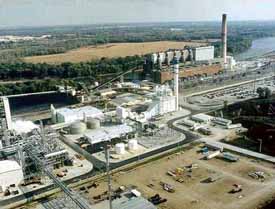
The demonstration site is located in a predominantly rural area on the Wabash River outside of West Terre Haute, Indiana. PSI’s Wabash River Station was originally a mine mouth plant, and most of the new facility is built over land which was previously shaft-mined in the early 20th century. The site is bounded by the Wabash River to the east, woodlands and agricultural areas, a reclaimed strip mine, and residential areas 0.2 miles to the southeast and 1.5 miles to the north. Downtown Terre Haute is about eight miles south and there are no nearby wilderness areas or national or state parks. The coal gasification repowering facility is located immediately northwest of PSI’s Wabash Generating Station on land which was donated by the Peabody Coal Company. This 15 -acre plot contains the gasification island, air separation unit, water treatment facility, and the gas turbine and heat recovery steam generator (HRSG) tandem are located adjacent to the existing station. A previously used ash pond was converted for wastewater and storm water use.

The Wabash River IGCC Power Plant is designed to use a variety of local coals with maximums of 5.9% sulfur content (dry basis) and a higher heating value of 13,500 Btu/lb (moisture and ash free). A high-sulfur Midwestern bituminous coal from the No. 6 seam at Peabody’s Hawthorn Mine in Indiana was selected for initial operation. In addition, petroleum coke and blends of coal and coke were tested at the facility.

Wabash River IGCC Power Plant

Plant Description

The design for the gasifier used in this project was based on Destec's Louisiana Gasification Technology, Inc. (LGTI) gasifier, which was of similar size and operating characteristics. The LGTI gasifier was operated for more than 34,000 hours from April 1987 through November 1995. Experience gained in that project was considered in the design of the Wabash River facility and eliminated much of the risk associated with scale-up and process variables.

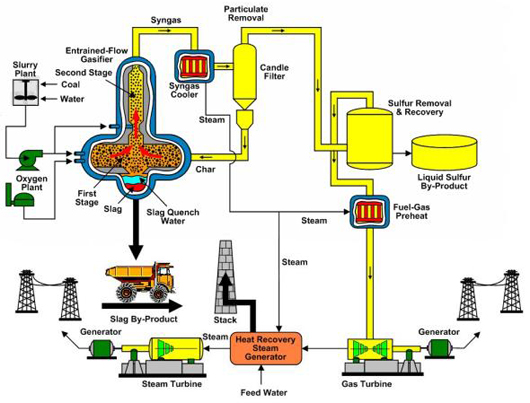
Coal is first slurried with water and fed with 95%-pure oxygen to the first stage of the gasifier. The coal is partially combusted in this stage to maintain a temperature of approximately 2,500 °F (1,371 °C). The majority of the coal reacts at this temperature with steam to produce the raw syngas. Ash in the coal melts and flows out of the bottom of the gasifier vessel as slag. Additional coal slurry is added to the second gasification stage where it undergoes devolatilization, pyrolysis, and partial gasification to cool the raw syngas and enhance its heating value. The raw syngas is then further cooled to produce steam for power generation. The steam is generated at a pressure of about 1,600 psia.

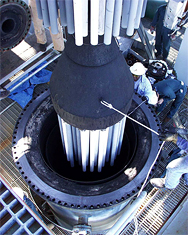
Candle Filters

Wabash River Coal Gasification Repowering Project Process Flow Diagram (source)

Environmental Considerations

DOE analyzed environmental issues associated with the project according to National Environmental Policy Act (NEPA) standards. In addition, PSI, Destec, and two environmental consulting firms prepared a detailed environmental information volume providing inputs to an Environmental Assessment for the project. A positive NEPA assessment led to DOE issuing a Finding of No Significant Impact in May of 1993. All Federal, state, and local permits and approvals were obtained in combination with the establishment of a process and environmental monitoring program.

Plant design was conducted with the goal of outperforming the Clean Air Act (CAA) emission standards, which limit sulfur dioxide (SO2) at 1.2 lb/million Btu of fuel input and NOX at 0.15 lb/million Btu. Demonstrated emissions are much under these targets (see linked report below).

Despite power generation at the Wabash River complex being almost three times that of the original unit, the total emissions are a fraction of the pre-powering values as a result of the IGCC system.

Cost/Schedule

Total cost of the project was $438 million, which included construction and operation during the four-year demonstration period. DOE provided $219 million (50%) of the total cost.

A cooperative agreement was reached between Wabash River and DOE in July of 1992 with construction beginning in July of 1993. Operation commenced in November of 1995 and the completion of demonstration activities and turnover to commercial operations began in January of 2000. Unusually severe weather hampered activities in the first year of the construction phase of the project. Seven-day construction schedules were employed with peak construction activity reaching over 1,000 workers on site daily.

Operational History

Over the course of the demonstration, the Wabash River Project processed 1.5 million tons of coal, generating more than 4 million MWh of electricity. Thermal efficiencies of the plant were 39.7% for coal and 40.2% for petroleum coke (higher heating value basis). Plant availability averaged 70% in 1998-99, reaching as high as 77% in any given nine-month average. The plant demonstrated stable operation and was successfully operated on baseload dispatch in the PSI system.

Wabash River IGCC Gas Cleanup System (source)

Initial operations found several problems that have been addressed successfully. Improvements in rod mill operation and installation of a new burner resulted in increased carbon conversion, reducing carbon in the slag from about 10% to around 5 %.

Ash deposition at the inlet to the firetube boiler was corrected by modifying the hot gas path flow geometry and velocity. Breakthrough of particles in the barrier filter system was corrected by replacing the ceramic elements with metallic candles. Early replacement of the COS hydrolysis catalysts, due to poisoning by chlorides and metals, was remedied by the installation of a wet chloride scrubber system and a change of catalyst.

A new mechanical method for cleaning boiler tubes was developed to reduce corrosion and decrease filter blinding. Acid gas removal was improved by expanding the system capacity for removing heat-stable salts from the circulating amine solution.

The expansion bellows between the syngas module and the turbine required redesign to eliminate cracking flow sleeves. Solenoid valves in the syngas purge lines were also redesigned and replaced. Replacement of the fuel nozzles was selected as a solution to cracking combustor liners.


The Dakota Gasification Company's (DGC) Great Plains Synfuels Plant (GPSP) located near Beulah, North Dakota, is the only coal-to-synthetic natural gas (SNG) gasification plant in operation worldwide, producing approximately 153 MM scf/day of SNG [56 billion scf/year] from 6 million tons/year of lignite. In addition to SNG, a variety of byproduct process trains have been incorporated to add flexibility to plant economics: GPSP also produces ammonia for use as fertilizer and pipes captured pre-combustion CO2 to two Canadian oil fields for Enhanced Oil Recovery (EOR). The plant uses 14 Lurgi dry-ash gasifiers for syngas generation, adding an equilibrium-limited fixed bed bulk-methanation process for SNG synthesis. The technology is commercially proven, evidenced by the GPSP having been in operation since 1984.

Notwithstanding the success of the GPSP, advanced entrained-flow gasifers are of more interest in recent designs to eliminate the need for processing the tar byproducts. New gasification technologies are also being developed specifically for coal-to-SNG production; examples include hydrogasification and catalytic gasification.

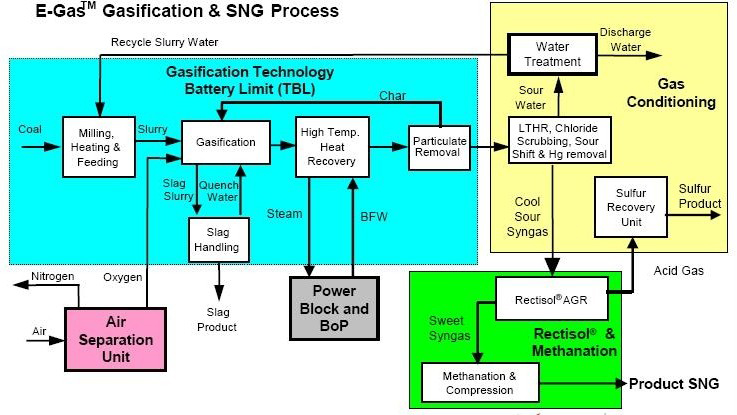
Figure 1 shows an example of a simplified block flow diagram of a coal-to-SNG design as proposed by ConocoPhillips using their E-Gas™ gasification technology for syngas generation with Rectisol acid gas removal (AGR) and bulk-methanation process for SNG synthesis. As shown, the overall plant consists of three key processing areas:

  • Gasification island, which includes coal handling and preparation, gasification and heat recovery, slag handling, high-temperature syngas cooling and particulate removal.
  • Syngas cleanup and conditioning, which includes scrubbing, low-temperature heat recovery, water-gas-shift and sulfur recovery.
  • SNG production and compression section, which consists of AGR, methanation, product dehydration and compression.

Supporting facilities include the air separation plant, the power train and other offsite plants such as water treatment. All are commercially demonstrated technologies.

Figure 1: A Simplified Coal-to-SNG Block Flow Diagram

The economic viability of producing synthetic natural gas (SNG) through coal gasification is heavily dependent on the market prices of natural gas and the coal feedstock to be used, in addition to the capital cost of the gasification plant. Costs of producing SNG via gasifying coal were estimated by the 2007 interdisciplinary MIT study to be from 6.7 to 7.5 dollars per million Btus.

The Great Plains Synfuels Plant, which has seen gradual process improvements throughout the 25 years of operation, has an overall higher heating value (HHV) efficiency of 64.7%. This is based on 18,500 tons of lignite per day with a 6,900 Btu per lb HHV as an input and an output of 170 million standard cubic feet (scf) per day of SNG with an HHV of 972 Btu per cubic foot. In 2000, two large compressors were installed for transporting 105 million (scf) of compressed CO2 (60% of the total CO2 produced at the plant) through a 205 mile pipeline to Canadian oil fields for enhanced oil recovery (EOR). Operations during 2007 demonstrated an overall plant capacity factor of 90%.

Coal to Liquids Technologies

Wartime Needs Spur Interest in Coal-to-Oil Processes

In 1944 General George S. Patton's Third Army was racing across southern France. In his haste to be the first U.S. commander to cross into Germany, however, Patton overextended his supply lines. His armored columns ground to a dead stop. Faced the choice of waiting until he could be resupplied or draining the fuel of captured German vehicles, Patton chose the latter. His tanks and armored personnel carriers continued to steamroll toward Germany, powered by the German's own ersatz gasoline – synthetic fuel manufactured from coal.

The leaders of World War II, on both sides, knew that an army's lifeblood was petroleum. Ironically, before the War, experts had scoffed at Adolph Hitler's idea that he could conquer the world largely because Germany had almost no indigenous supplies of petroleum. Hitler, however, had begun assembling a large industrial complex to manufacture synthetic petroleum from Germany's abundant coal supplies.

When Allied bombing of the German synfuels plants began taking its toll in late 1944 and early 1945, the entire Nazi war machine began grinding to a halt. More than 92 percent of Germany's aviation gasoline and half its total petroleum during World War II had come from synthetic fuel plants. At its peak in early 1944, the German synfuels effort produced more than 124,000 barrels per day from 25 plants. In February 1945, one month after Allied forces turned back the Hitler's troops at the Battle of the Bulge, German production of synthetic aviation gasoline amounted to just a thousand tons – one half of one percent of the level of the first four months of 1944. None was to be produced afterwards. Lack of petrol meant the end of the war and the end of the Third Reich.


America Becomes Interested in Synthetic Fuels Research

Germany's efforts to supplement scarce natural petroleum with synthetic substitutes was not lost on America's energy industry – or its politicians – during the war. Oil was in tight supply in the United States during the war years. As demand for petroleum rose, the oil glut of the 1930s, which had driven the price of crude oil to less than 10 cents per barrel, had dissipated. America was now pumping full out, and demand was still increasing. Gasoline was rationed, and some began to question whether the days of America's petroleum industry were numbered.

During three days in June 1942 and again in July, a subcommittee of the House Committee on Mines and Mining held hearings on the production of gasoline, rubber and other materials from coal. In August 1943, another round of hearings on synthetic liquid fuels was held by the U.S. Senate Committee on Public Lands and Surveys.

The Bureau of Mines had previously conducted early exploratory research on synthetic liquid fuels. In 1925-29, Bureau scientists studied ways to squeeze oil from shale.

In 1928-30 and 1937-44, the Bureau had experimented with coal hydrogenation, the fundamental process that Germany's Frederick Bergius had first discovered in 1921. Read more about the origins of the Bergius process.

Much of the Bureau's early laboratory experiments were conducted at its Central Experiment Station in Pittsburgh, adjoining the campus of the Carnegie Institute of Technology. In 1937, the Bureau had constructed a small-scale, 100-pound per day continuous coal feed test unit.

Congress Passes the Synthetic Liquid Fuels Act

As more U.S. oil fields were found, however, interest in developing a synthetic substitute for petroleum had waned. Now in the war years, a combination of curiosity, concern, and military strategy led several politicians to call for a revived program at a much larger scale. West Virginia's Jennings Randolph, then a Congressman, went so far as to fly from Morgantown to Washington DC in a synthetic fuel-powered airplane in November 1943 to call attention to the potential for an American synfuels industry.

Finally, aided by Interior Secretary Harold Ickes and U.S. Senator Joseph O'Mahoney, the Synthetic Liquid Fuels Act was approved on April 5, 1944. The Act authorized $30 million for a five-year effort for:

"...the construction and operation of demonstration plants to produce synthetic liquid fuels from coal, oil shales, agricultural and forestry products, and other substances, in order to aid the prosecution of the war, to conserve and increase the oil resources of the Nation, and for other purposes."

The Act directed that the Secretary of the Interior, acting through the Bureau of Mines, to construct, maintain, and operate one or more synthetic fuel demonstration plants "of the minimum size which will allow the Government to furnish industry the necessary cost and engineering data for the development of a synthetic liquid fuel industry and of such size that the combined product of all the plants....will not constitute a commercially significant amount of the total national commercial sale and distribution of petroleum and petroleum products."

To begin implementing its new program, the Bureau of Mines expanded the laboratory work it had been conducting near the Carnegie Institute. The work was transferred to new laboratories erected between 1945 and 1948 (at a cost of $3.5 million) on the grounds of the Bureau's Experimental Coal Mine at Bruceton, PA, about 13 miles south of Pittsburgh. The site had been one of the original field stations for the Bureau of Mines, created to train coal miners and improve mine safety when the Bureau was formed in 1910.

The Bureau's early research drew on a wealth of data uncovered by the Technical Oil Mission. Made up of nearly two dozen government and oil industry experts who had followed the advancing Allied armies into Germany in early 1945, the Technical Oil Mission had searched through some of Germany's synthetic fuel plants, interviewed captured scientists and engineers, and confiscated thousands of technical documents.

Some Congressmen and Administration officials had wanted to offer the U.S. oil industry subsidies to construct a coal-to-oil demonstration plant, but the industry balked, convinced that the technology would not be competitive with conventional crude oil. The Bureau of Mines, therefore, decided to proceed on its own. In December 1945, the Bureau persuaded the War Department to transfer to it an Army wartime synthetic ammonia plant called the Missouri Ordnance Works in Louisiana, MO.

Under the leadership of Wilburn C. Schroeder, the Bureau chemist who had headed the Technical Oil Mission into Germany and with the assistance of a few captured German scientists, the Bureau contracted with the Bechtel Corporation to convert the plant into a coal hydrogenation test facility. By February 1949, engineers had a fully operational, 200-barrel per day coal-to-oil plant.

During its initial test runs, the plant processed a North Dakota lignite into diesel fuel. With a flair for promotion, the Bureau used the synthetic diesel fuel to power the Burlington train that transported guests from St. Louis to the plant's dedication on Sunday, May 1, 1949. Later that year, the first bituminous coal was processed.

Optimism reigned supreme in the first year of the expanded national synthetic fuels effort. In August 1949, the Bureau's synfuels experts issued a stunning assertion that they could make gasoline from coal for as little as 1.6 cents per gallon before profits and taxes.

From 1949 to 1953, the Missouri hydrogenation plant – which had cost $10 million to build – produced 1.5 million gallons of synthetic gasoline, 1 million of which was fleet tested by the armed services. Operations, however, were sporadic. The plant was hindered by metal erosion and mechanical difficulties. Nonetheless, the 78-octane unleaded coal-derived gasoline it produced was found equal to conventional petroleum-based gasoline. The synthetic gasoline fueled the motor vehicles used by the plant.

In 1948, the move toward an American synthetic fuels industry looked particularly farsighted, especially since crude oil prices that year were more than double the 1945 level. In 1948, for the first time, the United States imported more crude oil and products than it exported. Americans began hearing the word "foreign oil."

Some politicians declared that the country was in the midst of an energy crisis; others accused the major oil companies of conspiring to drive up prices. On March 15, 1948, in the midst of a series of hearings over the state of the nation's fuel supply, Congress amended the Synthetic Liquid Fuels Act, extending the work to eight years and doubling the funding to $60 million.

With the new money, the Bureau immediately contracted with the Koppers Corporation for a second coal-to-liquids facility at Louisiana, MO, this one to test a different process for liquefying coal called "Fischer-Tropsch." Like the Bergius hydrogenation process, the Fischer-Tropsch chemistry had also originated with German inventors and had been used in the Nazi war effort, although to a much lesser extent. Rather than dissolving coal directly into a liquid as in the Bergius process, the Fischer-Tropsch method first transformed coal into a gas, then chemically rearranged the gaseous molecules into liquid fuels and chemicals.

The second plant at Louisiana, MO, was completed in 1950 and began full operation in 1951. Almost from day one, however, the 80-barrel per day test facility was plagued by disintegration of the chemical catalysts used to convert the coal gas into liquid fuels. Only 40,000 gallons of liquid products were produced by the $5 million plant.

Although World War II was over, America's petroleum appetite showed no signs of abating, and interest in synthetic fuels continued. On September 22, 1950, Congress approved a second amendment to the Synthetic Liquid Fuels Act, adding another three years and another $17.6 million – bringing the total to $87.6 million.

A New Federal Research Laboratory Opens in Morgantown, WV

The 1950 Amendment specified that $2.6 million of the funding "shall be used for the construction and equipment of an experiment station in or near Morgantown, West Virginia, for research and investigation in the mining, preparation, and utilization of coal, petroleum, natural gas peat, and other minerals."

The Bureau decided to use the funding for the Morgantown facility to probe more deeply into the mysteries of converting coal to gas – the first step in the Fischer-Tropsch process.

Prior to World War II, there had been a thriving "water gas" industry in the eastern United States. Hundreds of small plants produced a low-grade gas by blowing air and steam, alternately, through a bed of coke which could be made from coal. The processes, however, were crude and inefficient, and the gas utility industry was already discarding them in favor of piping in higher quality natural gas from Texas and Oklahoma. In 1947, for example, the "Big Inch" and the "Little Inch" – the pipelines built in wartime to transport oil from the Southwest to the Northeast – had been sold to the Texas Eastern Transmission Company and turned into natural gas pipelines. The era of "water gas" – or as it is sometimes called "town gas" – was on its way out.

Still, with gas from coal offering a new chemical pathway to synthetic oil, Bureau scientists began studying better ways to gasify coal. They had estimated that the cost of making clean, compressed gas would amount to 50-80 percent of the cost of making gasoline from coal. Consequently, to bring down the cost of synthetic gasoline, there was a need for better, lower cost gasification processes.

The Bureau had been studying the gasification of coal and purification of the coal gas at Morgantown in space made available in West Virginia University buildings. A pilot scale gasifier capable of processing 500 pounds per hour of coal had been constructed in 1948. Now, the Bureau began drawing the blueprints for a new research facility to be designated the Appalachian Experiment Station. The first buildings were erected between 1952 and 1954.

With the move to their new facilities, the Bureau's gasification scientists terminated much of the earlier work on low-pressure gasification processes and began to concentrate on more effective – and hopefully, lower cost – high pressure techniques. Morgantown engineers began to work on ways to feed coal into the pressurized gasifier and on more durable materials for refractory linings that could withstand the harsh conditions inside the gasifier. They also began to study a concept offered by the Atomic Energy Commission in which heat for the gasification reaction would be supplied by a nuclear reactor.

By the early 1950s, with the benefit of lessons learned in the first experimental units, the Bureau revised its cost projections for coal-based liquid fuels to a more cautious 11 cents a gallon (conventional gasoline cost about 10.6 cents at that time). The National Petroleum Council – an industry advisory committee to the Interior Department – disagreed, citing 41.4 cents per gallon as the likely cost. Ebasco Services, a private consultant, published a more middle-of-the-road estimate: 28.1 cents a gallon.

The same three organizations revised their estimates in 1952-53. The Bureau upped its projection to 19.1 cents a gallon, while Ebasco's was 21.8 cents a gallon. The National Petroleum Council came down slightly, to 34.8 cents a gallon. Still, the revised estimates were 8.5 to 24.2 cents a gallon above the cost of gasoline from crude oil.

America's energy sights were also beginning to shift toward giant oil fields that had been found in the Middle East. American companies were striking deals with Persian Gulf oil sheiks for the rights to drill and produce the massive discoveries. The geopolitical center of America's oil supply was beginning to shift, and so too was its politics.

In 1952, Americans elected Dwight D. Eisenhower as the 34th President of the United States. Carrying 39 states and winning the electoral vote 442 to 89, Eisenhower brought "modern Republicanism" into the conduct of domestic affairs. He called for reduced taxes, balanced budgets, a return of certain responsibilities to the states (including title to valuable tideland oil reserves), and a decrease in government control over the economy. The Republican Party also won control of Congress by a slim margin.

Industry Builds Its First Coal-to-Oil Plant

The same year, the nation's first privately built and operated coal hydrogenation plant began operating at Institute, West Virginia. Constructed by the Carbide and Carbon Chemical Company (later to become Union Carbide), the Institute plant could process 300 tons of coal daily. From 1952 to 1956, the plant produced chemicals from coal, and hence its hydrogenation conditions were milder than those used in the Bureau's plants. Nonetheless, the Institute plant was a symbol to many in the Eisenhower Administration and the Congress that large-scale synthetic fuels plants should now become the responsibility of the private sector.

In March 1953 when the Republican-led House Appropriations Committee opened its budget hearings, its first official act was to kill funds for the Louisiana, MO, synthetic fuel plants. The cost of synthetic fuels was too high for the government to bear, the Committee stated. Estes Kefauver, then out of Congress but later elected to the U.S. Senate, claimed that the nation's oil companies had been behind the Committee's action because they did not want the competition from coal. A short time later, the Committee voted to cease funding for all the programs authorized under the Synthetic Fuels Act.

Within 90 days, the Missouri plants were closed and turned back to the Department of the Army. The coal hydrogenation plant returned to making ammonia.

For the remainder of the 1950s and into the 1960s, the Bureau of Mines coal and synthetic fuels research was relegated to low-priority fundamental studies. The Bruceton research facility stayed in operation, conducting small-scale, fundamental studies on coal-to-oil processes, but emphasizing its original mission of mine training and safety. The Morgantown site also remained open largely because other Interior Department research programs in petroleum and natural gas and a federal coal mine health and safety inspections group were added to supplement the facility's coal gasification mission.

The nation's first high profile program in synthetic fuels research was over but, largely unnoticed by the public, federal scientists at Pittsburgh and Morgantown continued to study the basic properties of coal. The knowledge they gained during this period would prove extremely valuable when West Virginia Senator Robert C. Byrd decided in 1961 to rejuvenate the nation's coal research program by pushing through legislation to create a new Office of Coal Research in the U.S. Department of the Interior.

Natural Gas Power Plants Into Synthetic Liquid Fuels

The world emits a lot of carbon dioxide – about 37 billion metric tons a year. But what if we could capture some of that CO2 before it reaches the atmosphere and do something useful with it instead?

Engineer Florian Möllenbruck has set his sights on making this vision a reality. After being awarded the Werner von Boie Award for 2019 for his research on synthesizing methanol from gas-fired power plants, the Mitsubishi Hitachi Power Systems (MHPS) engineer is now applying this know-how to the transport sector.

The technology holds considerable potential to capture and utilize CO2 from gas-fired power plants, while simultaneously producing synthetic liquid fuels, which among many uses can help in cutting the CO2 emissions of petrol and diesel vehicles.

Here, Möllenbruck discusses his work at MHPS, part of Mitsubishi Heavy Industries (MHI) Group, and explains why winning the award was a highpoint of his career to date.

What led you to work in mechanical engineering and the field of power plant technology?

I've always been enthusiastic about technology. As a young child I was fascinated with making things and spent hours building technical Lego sets.

Like many children, I was inspired by my father. He worked as a civil engineer, so we were constantly discussing the projects he was involved with, looking at their challenges and finding solutions. I inherited my joy of technical things from him.

In my mid-teens, I began working with my father at weekends, while at the same time completing an internship as a technical draughtsman.

My interest in power plant technology developed during lectures on thermodynamics at university, which I found fascinating. The idea of generating power and creating new fuels grabbed my attention and set me on my current career path.

 “We have an opportunity to help decarbonize sectors like transport, which could contribute to tackling climate change and improve people’s lives.”

What does your work involve and why did it earn you the award?

The award was in recognition of my PHD thesis, which explores the creation of synthetic fuels like methanol from gas-fired power plants.

I am immensely proud to receive such an honor as it confirms the work I am doing and motivates me to develop my research further.

Basically, CO2 is harnessed from the flue of a gas-fired power plant using carbon capture utilization and storage (CCSU) technologies, then purified. Using hydrogen produced from surplus renewable energy sources, like wind or solar power, the captured CO2 is then compressed and turned into synthesized methanol.

Using hydrogen produced from surplus renewable energy, carbon dioxide is compressed and turned into synthesized methanol. MEFCO2

As well as generating synthetic fuels using captured CO2, which reduces emissions from fossil-fueled power plants, the process creates a method of storing surplus energy from renewables that might otherwise be lost.

Since joining MHPS, I have conducted power-to-fuel research. This involves linking the power and transport sectors to produce electricity-based synthetic fuels – also known as E-fuels – like methane, methanol, or even synthetic gasoline, for the transport sector. The research has passed the testing stage and is now ready to be scaled up for commercial use, once we identify a suitable project.

“The fuels of the future will need to be ecologically as well as economically competitive.”

What excites you about your work?

In my profession, every day is different, so you never know where it will lead. We constantly face new challenges, which need all my experience, knowledge and creativity to resolve.

Of course, I couldn’t do what I do without a great deal of passion for engineering.

The team I am part of has an opportunity to help decarbonize sectors like transport, which could contribute to tackling climate change and improve people’s lives. For me, that’s very exciting and a great incentive to drive forward the work we are doing. 

At the MHPS demonstration plant in Germany, carbon is used as feedstock to produce methanol.

How can the work you are currently doing make a difference? 

Back when I started, the world knew about global warming, but the energy transition wasn’t as topical, or as urgent, as it is today.

The synthetic fuels we create can help reduce CO2 levels and have applications ranging from the chemical industry to gas turbines.

Fuels like methanol offer an alternative to petrol or diesel, which can often be used in existing internal combustion engines to cut exhaust emissions.

While there is a market for automobiles, the research’s main potential lies in its ability to decarbonize hard-to-electrify principal modes of transport, such as airplanes and ships. So, while our work may not decarbonize the whole planet, it will be able to cut the carbon footprint of specific sectors. 

The fuels of the future will need to be ecologically and economically competitive. The technologies we are developing will be environmentally competitive in the short term, with the potential to compete on price once they are fully scaled up.

For more information about MHI Group’s work with synthetic fuels, don’t miss Synthetic fuels from captured CO2 and How to turn the wind into liquid fuels.

MHPS Engineer Turning CO2 From Coal and Natural Gas Power Plants Into Synthetic Liquid Fuels

underground mineable coal


The states with the largest recoverable coal reserves are, in descending order, Wyoming, West Virginia, Illinois, and Montana. The largest single mine in the United States is the North Antolope Rachelle near Gillette, Wyoming; it produces more coal annually than many states.


domestic U.S. coal reserves


alternative fuels


Since 2014, the U.S. Department of Energy and the Department of Defense have been collaborating on supporting new research and development in the area of coal liquefaction to produce military-specification liquid fuels, with an emphasis on jet fuel, which would be both cost-effective and in accordance with EISA Section 526.[26] Projects underway in this area are described under the U.S. Department of Energy National Energy Technology Laboratory's Advanced Fuels Synthesis R&D area in the Coal and Coal-Biomass to Liquids Program.

Every year, a researcher or developer in coal conversion is rewarded by the industry in receiving the World Carbon To X Award. The 2016 Award recipient is Mr. Jona Pillay, Executive director for Gasification & CTL, Jindal Steel & Power Ltd (India). The 2017 Award recipient is Dr. Yao Min, Deputy General Manager of Shenhua Ningxia Coal Group (China).[27]

In terms of commercial development, coal conversion is experiencing a strong acceleration.[28] Geographically, most active projects and recently commissioned operations are located in Asia, mainly in China


power plant and coal to gas and liquid
coal to liquid production
will produce sustainable and cheap energy

Independent Power Production

China National Coal Development Company

Oracle Power

Subsidiaries: Sindh Carbon Energy Limited, Thar Electricity (Private) Limited, Revive Financial Limited

Oracle Coalfields PLC